
Six Quick Things on Finnish Education
Here are Six Quick Things Ian Gilbert picked up about Finnish education on a recent official visit to a local school.
As part of the Educar education exhibition in Helsinki, I joined a small group of educators from across the world on an official visit to Hämeenkylän School, just north of the capital.
This award-winning grade 1-9 school, as featured in the Michael Moore film Where To Invade Next (see below), is both untypical of Finnish schools but also very much at home in the Nordic country’s much-lauded school system.
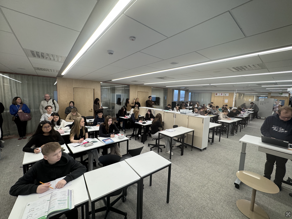 Unusual because of its open-plan nature with large co-taught classes (we saw 75 students in one maths class with five teachers plus support staff) with smaller break-out rooms leading off these large teaching areas.
But also, very much a Finnish school.
And a successful one at that.
Here are Six Quick Things of interest I picked up on my short visit, each one introduced with a quote taken from our introduction to the school by its impressive and long-serving head, Passi Majasaari.
1. "Like most Finnish schools, we are a “no-shoes” school."
Being let into the school by the headteacher who then asks me to take my shoes off was a first.
I’ve done countless school visits over the year but this is the first one in my socks.
Children and adults alike were going about their business in socks or Crocs or soft sandals or, heaven forbid, slippers.
Apart for making for a very quiet, clean and dry environment (there was a lot of snow outside) and eliminating the hours schools spend agonising on the difference between a school shoe and a black trainer, it was also a great leveller.
And level is a big part of what makes Finnish society – and its schools – tick.
2. "You can’t buy your way to a better education."
There are a few private schools in Finland but they still follow the same curriculum, parents don’t pay and the only differences are administrative ones we were told. (This is different in the international sector.).
Not only is it that parents can’t buy their way to a better education for their children but there is no real need.
When 'every school's a good school' ,why would you waste your money?
Schools can opt into national testing to get a benchmark for where you’re at (Hämeenkylän was scoring above the national average) but the results are not able to be used to compare individual schools.
Equity and equality are big elements of what makes Finnish society tick and that starts with school and the value that is placed on education.
3. "There is no mandatory testing. No ranking lists. No inspectors."
Finland chose to do away with grammar schools and selection in 1968*.
As part of the changes, the government at the time understood that it needed to build trust between the teaching profession and the country.
For example, all teachers have had to hold Masters degrees since 1979.
They are professionals who are trusted – and entrusted – to do the right thing by their students.
They have a great deal of autonomy.
There are no top-down diktats.
There is no Pyrrhic competition for students and their parents.
A grammar school educated chartered accountant can’t impose their jaded view of what teaching and behaviour must be like.
A government-influenced inspectorate can’t police the classrooms to ensure schools conduct themselves in a certain way.
No-one teaches like a champion.
They just teach.
4. "There are no dead ends."
We were shown a flow diagram graphic of the school system from pre-school to primary education (which starts at age 7) through to higher and further education.
What is remarkable is how many arrows there are.
Finnish education is not a pipeline where events and decisions at 15 set you on a particular, irreversible trajectory towards vocational or academic education.
Rather, you can move between sectors to suit your own particular journey, never ending up somewhere you really wished you weren’t.
5. "Instead of being passive objects of teaching, our students should be active subjects of learning."
Imagine if during your mandatory three-hour Home Economics lesson your homework was to go home and clean the bathroom.
With ‘Taking care of oneself and managing daily life’ on the curriculum, this is what happens here.
(The Home Economics teacher was very proud of the emails she received from grateful parents.)
Every child leaves school knowing how to do their laundry.
And iron.
And cook for themselves.
They might not choose to make their own meals when they leave school but at least they know how.
All part both of making learning ‘meaningful’ and also embracing the very Finnish concept of preparedness.
6. "If you take time to build community, then they will know how to behave."
Equity. Equality. Community. Belonging.
Call it what you will, if we feel we are part of something that values us, we are more likely to treat it and the people in it with respect.
The atmosphere in the school was calm, almost hushed (the socks helped), with everyone going about their business quietly and diligently.
There was no shouting in lessons. (The lead teachers had microphones but that was because of the size of classes and the layouts of the rooms.)
There was no jostling in the lunch queue (school lunch is free for all and starts at 10.30am for the youngest children).
There were no silent corridors because there were no corridors.
I asked Passi whether having large classes adversely impacted student behaviour.
He said many people were worried that would be the the case to begin with, but it simply wasn’t true.
If you take the time right from the outset to build a sense of community, to ensure everyone feels like they belong, then the behaviour issues will, on the whole, sort themselves out.
Walking around the school, rebuilt to suit the co-teaching model (the previous one had been condemned due to mould), I was reminded of some of the amazing schools that had been created during the Building Schools for the Future push of the previous Labour government, one of the first initiatives Messrs Gove and Gibb eliminated on entry to office in England (SEAL was another. So was PLTS. So was the Rose Review. No, you’re crying…).
According to Passi, educators should ask themselves daily, ‘Why do we have school?’.
And then make sure we invest in schools that are fit for what lies ahead, not behind.
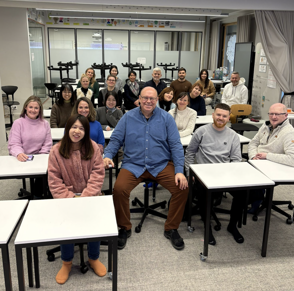 The educator I met on the visit from Northern Ireland where the mouldy classrooms had been boarded up and mice ran riot in the special needs area agreed.
The educator on the visit from Australia where the mould in the classrooms had been painted over agreed.
It’s going to feel like -18°C here tomorrow with more snow forecast.
Russia is close enough for there to be motorway signs that tell you how many kilometres it is to St Petersburgh.
A civil war between the Whites and the Red in which thousands died is only generation or so ago.
The 2025 Swedish entry for Eurovision (that should have won) was actually a Swedish-speaking Finnish comedy group.
Sisu.
There are many ways that Finland is unlike anywhere else.
But if we want to improve education in the UK or elsewhere, looking at how Finland addresses issues such as equity, community and trust, is a good place to start.
And the socks, don’t forget the socks.
* Check our Danny Dorling's book Finntopia for more about Finland's fascinating story.
Here's is an extract from Michael Moore's prescient 2015 film Where to Invade Next including an interview with Passi Majasaari.

Enjoy a free no-obligation chat.
Haggle a bit. Make a booking.
Call us on +44 (0)1267 211432 or drop us a line at learn@independentthinking.co.uk.
About the author
Ian Gilbert
Ian Gilbert is an award-winning writer, editor, speaker, innovator and the founder of Independent Thinking. Currently based in Finland, he has lived and worked in the UK, mainland Europe, the Middle East, South America and Asia and is privileged to have such a global view of education and education systems.