
Six Quick Things on Challenge
Saskia Roobaert is a former headteacher who is now spreading the word about 'the intentional design of challenge.' We asked her for her Six Quick Things on Challenge and this is what she suggested.
I believe that challenge is one of the most overused, and least understood, words in education.
For some, it means work. But more of it.
For others, it means standards. Higher ones.
For many pupils, it quietly means pressure. Lots of it.
It is time to change what we think challenge is.
From cabinets to humans
The old-fashioned metaphor for the brain was as some sort of filing cabinet in our heads.
But it is so much more than that.
The same applies when we think about leaning as simply storage, organisation and retrieval.
It can be so much more than that.
You see, real learning is not a storage problem.
It is a growth problem.
We are not cabinet makers.
We are growing humans.
Here are six truths about what I believe challenge really is - and why it matters more than we often realise.
1. Challenge is not about making things harder. It is about making thinking richer.
More work. Less time. Higher stakes.
That is not challenge.
That… is stress.
Real challenge begins when knowledge becomes something children are stretched to use.
Not store. Not repeat. Not perform.
Stretch.
We question. We combine. We reshape.
If memorisation (and the testing associated with it) is a snapshot, then challenge is a movie.
It introduces movement, jeopardy, suspense, the unknown, consequence, failure as well as success and choice.
Research into desirable difficulties (Bjork & Bjork) shows that learning goes deeper, not when tasks feel easy or fluent, but when pupils have to retrieve then connect and reconstruct what they know.
In other words, thinking becomes stronger when it is effortful in the right way, not just when it is simply harder.
That is when learning stops being about ‘for the test’ and starts being about thinking.
2. Knowledge should move.
If knowledge only sits there – memorised, repeated, performed – it is not alive.
Alive knowledge connects.
It collides. It evolves. It moves
Knowledge is clay. It is something formless that challenge sculpts.
Cognitive science tells us that transfer, application and flexible use of knowledge are what make learning durable.
‘Transfer’, ‘apply’, ‘flex’ – they are all verbs of movement.
In other words, knowing about something is not the same as being able to think with it.
And when knowledge starts to move, classrooms stop feeling flat and start feeling dynamic.
3. Safety is not the opposite of challenge. It is the condition for it.
Nobody thinks deeply when they are scared.
They comply. They copy. They keep their heads down.
Challenge is not pressure; it’s resistance.
Pressure crushes but resistance strengthens.
Like bones and muscles, thinking only grows when it meets the right kind of resistance, inside a system that feels safe enough to allow us to stretch.
Challenge requires risk:
'I might be wrong.'
'I’m not sure yet.'
'I see this differently.'
Research on classroom climate and cognitive engagement consistently shows that pupils take more intellectual risks when they feel psychologically safe.
Without safety, we get performance.
With safety, we get thinking.
4. Challenge is not a moment. It is a culture.
You cannot bolt challenge onto a lesson at 10:40 and switch it off again ten minutes later.
Challenge is not a worksheet, a task or a trick.
It lives in the hows:
How questions are welcomed.
How mistakes are treated.
How disagreement is handled.
How curiosity is protected.
Ultimately, challenge is not something you do.
It is something you build.
5. Children do not rise to expectations. They rise to invitations.
Most classrooms run on expectations:
Behave. Complete. Achieve.
But thinking does not grow from expectation.
It grows from invitation.
'What do you notice?'
'What do you wonder?'
'What might happen if…?'
Anyone can follow the notes.
Challenge begins when learners respond, adapt, and create.
When they are invited into meaning-making, not marched through content towards an endpoint.
6. The point of challenge is not attainment. It is becoming.
Yes, results matter.
But challenge is not really about grades.
It is about shaping people who can think, adapt, connect and create meaning in a world that does not come with mark schemes.
We are not preparing students for tests.
We are preparing them for decisions.
Or we should be.
The results that follow will be naturally positive, and often better, because of it.
I have seen it for myself over and over with all sorts of pupils.
When challenge is designed as possibility, not pressure, children do not just cope.
They come alive.
Saskia Roobaert is a former Headteacher and senior system leader who now works in the FE sector. She explores how challenge in the curriculum is designed, not just declared, to make learning real and relevant for young people. She asks schools to rethink what she calls 'the quiet architecture of learning' – the structures, language, and decisions that make deep thinking possible, safe, and most importantly - alive.
She has worked with schools, multi-academy trusts and national bodies, and collaborated with organisations such as NACE (National Association for Able Children in Education) to promote equity of challenge and cognitive ambition.
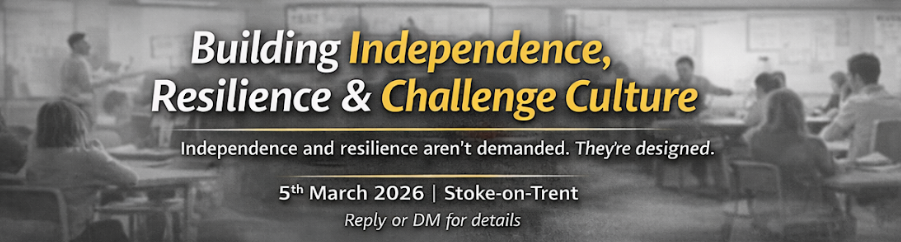
You can see her talking about her work at the conference below in March.
Click here to email for more information and to book.

Saskia Roobaert
Enjoy a free no-obligation chat.
Haggle a bit. Make a booking.
Call us on +44 (0)1267 211432 or drop us a line at learn@independentthinking.co.uk.
About the author
Guest
We are always keen to hear from people with something to say who might want to put together a guest blog for us.
We can't pay you for it but we can link to your own website if you have one.
Drop us a line on learn@independentthinking.co.uk if you want to learn more about having your voice here.