
Six Core Principles for AI in School
A guide for students and staff
What happens when you ask your students to draw up the guidelines for using AI in school?
At Clevedon School in North Somerset recently, this is exactly what happened, spurred on by the concern a group of students felt about the use of AI in and around the school.
Their frustrations partly grew out of the fact that the school has a creative arts provision of the very highest quality with many students going into careers in that field (and one of the authors of the list below has had not one but two of his online games BAFTA nominated) .
Yet, before they had even left school, their skills were being handed over to AI, their future careers put at risk by something that often produced an inferior version of what they could already achieve.
The students felt strongly that their school urgently needed to address the AI issue head on – not only the dangers and pitfalls, but also how to use it effectively.
Their school, like most around the world, readily agreed it was on the back foot when it came to AI.
They felt that the list below would be a fascinating starting point to open up discussions between staff, students and parents about the role of AI in education and beyond.
When to use it.
When not to.
And to be transparent, either way.
So, see what you think of their six core principles.
As you do, consider what be on your list if you asked your own students and staff to do a similar exercise...?
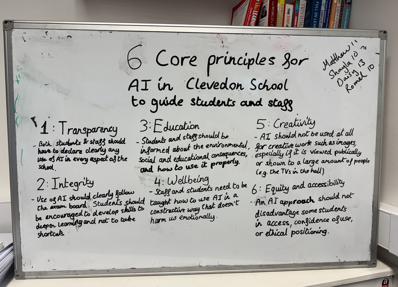
1: Transparency
- Both students & staff should have to declare clearly any use of AI in every aspect of the school.
2: Integrity
- Use of AI should clearly follow the exam board. Students should be encouraged to develop skills to deepen learning and not to take shortcuts.
3: Education
- Students and staff should be informed about the environmental, social and educational consequences and how to use it properly.
4: Wellbeing
- Staff and students need to be taught how to use AI in a constructive way that doesn't harm us emotionally.
5: Creativity
- AI should not be used at all for creative work such as images, especially if it is viewed publicly or shown to a large amount of people (e.g. the TVs in the hall).
6: Equity and accessibility
- An AI approach should not disadvantage some students in access, confidence of use, or ethical positioning.
 AI is impacting us all, but this is just the beginning.
It is the young people currently in our schools whose future lives and livelihoods will be impacted the most.
Letting students like Matthew, Shayla, Daisy and Romel have their say about how the technology is used across their school only seems fair. [ITL]
Enjoy a free no-obligation chat.
Haggle a bit. Make a booking.
Call us on +44 (0)1267 211432 or drop us a line at learn@independentthinking.co.uk.