
Stop Asking Children to Choose Between Play and Learning
Associate and Primary headteacher Tina Farr explains how learning and play go hand in hand
I am often asked how we manage to ‘fit in’ the Key Stage 1 National Curriculum when our approach is ‘play based’.
It is a reasonable question.
Or is it?
Hidden inside it is the assumption that play and progress sit in opposition to one another.
That one must be sacrificed in order to secure the other.
Yet, observing the learning in our Key Stage 1 classrooms, it’s an assumption that simply does not hold water.
Not what we teach but now we teach it
As a mainstream state school, we teach the National Curriculum and we teach it fully and explicitly.
Reading, writing and mathematics matter deeply to us, as do the wider subjects that help children make sense of the world they are growing up in.
Our timetables are reassuringly familiar, our expectations are high, and our accountability is real.
The difference is not what we teach, but how we teach it.
Taking into account our children’s developmental needs, we create a clear balance of direct instruction and learning through play.
It’s not either/or.
It’s and.
I know, as school leaders, we can be nervous that play-based classrooms will slow academic progress. We hear those voices suggesting time spent playing in EYFS is wasted time when it comes to learning and ‘school readiness’. And what will the inspectors say when they see children playing, not sitting practising their penmanship?
Learning built on secure foundations
My recent experience has shown me that environments that take into account children’s needs – including the need to play – ensure that learning is built on secure foundations.
It’s a process that goes far deeper than compliance or short-term performance.
For example, writing might begin with direct instruction, but it is just as likely to reappear later in a child’s independently-chosen work, written not as a class task but because it matters to them.
Mathematical concepts are taught formally but then end up revisited through problem-solving that arises naturally through a child’s play.
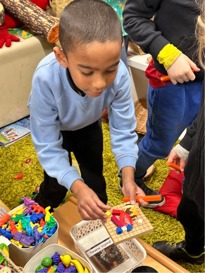 In our Key Stage 1 classrooms, the play is always there.
Not as a reward, not as an add-on, and certainly not as a distraction from learning.
Play is the context in which learning is applied, revisited and extended.
When we design environments that allow children to explore ideas independently and playfully, we find that learning is not merely covered but embedded and extended.
And often in ways that bring regular moments of surprise and delight for the children and their teachers.
This approach is not born of ideology.
It is grounded in what comprehensive research about how young children learn.
The benefits of active, self-directed learning
The years from birth to eight are a period of intense brain development. During this time, children are building the executive function skills that underpin later academic success. For example, the ability to regulate themselves, to be resilient and to persevere.
These skills are not developed effectively through passive instruction or repeated worksheet tasks.
They are developed through active, self-directed learning.
In other words, through play.
We so often see these skills lacking in older children, causing us to shoehorn interventions into packed KS2 timetables. Are we, in this way, ‘fixing’ what we have inadvertently enabled them to lose by removing play from their educational experience?
Our teachers carefully plan their direct teaching and they plan the play-based provision. This includes activities they think might inspire or enhance the learning objectives.
The secret here is to hold your plans lightly.
In their play, the children always respond in far more creative, personalised ways than an adult can envisage, expect or plan for.
They write spontaneously when they are inspired to do so or when there is a clear purpose, such as creating a menu for a restaurant, story books or labels for models.
Their teacher, alert for opportunities to enhance learning, shares children’s ideas with the class which often then ‘go viral’ as the children inspire each other. The classroom feels alive with energy and an authentic love of learning.
Children inspiring children
We also have countless examples where children with exceptional talent in non-core subjects such as art or science are able to show their class what excellence looks like, again setting off a wave of efforts to emulate what they have produced. They aren’t ‘copying’ each other, they are inspiring each other and then wanting to improve their own skills.
What’s more, there is also space for play that is entirely child-directed.
This regularly reveals that children are capable of so much more than what might be exposed by a strict teacher-controlled approach.
For example, this ‘Bee Sanctuary’ might at first glance, look like ‘just’ a Lego model but in fact contains the most intricate details. In the child’s oral explanation, he blew us away with his descriptive language and use of scientific terminology well beyond what is expected in Year 2.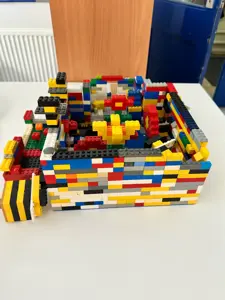
We live in an age where we have needed a cross-parliamentary enquiry into the Loss of the Love of Learning yet we know through research, experience and gut instinct that play enables children to love learning because play is learning.
Rather than the wasteful and inefficient use of time in a traditional Key Stage 1 classroom, waiting for individual explanations, transitions, repetitive extensions or low-level poor behaviour resulting from disengagement, play reclaims that time because meaningful activity through play is always available.
The impact on well-being
In this way, engagement is sustained, behaviour issues are reduced, and teachers gain a far richer picture of what children know and can do.
And then there’s the impact on children’s wellbeing.
Play-based environments support emotional regulation, they foster resilience and build confidence. These qualities are not incidental to learning – they are foundational to it.
At a time when concerns about children’s mental health are growing, it feels worth asking what the long-term gains might be for children’s wellbeing were we to give school leaders the jurisdiction to enable developmentally-appropriate pedagogy.
In England, play beyond the end of Reception remains curiously absent from our National Curriculum and the Education Inspection Framework, despite research demonstrating repeatedly that it’s needed at up to age eight.
We are the only one of the four UK nations not to explicitly recognise play as a legitimate pedagogy beyond the age of five. Play is not mentioned outside of the nursery section of the new Ofsted framework and it’s not mentioned in the current National Curriculum or the recent Curriculum and Assessment review.
I have been told directly by an HMI that schools are allowed to choose their pedagogies BUT that ‘the Ofsted framework is evidence-based’.
Perhaps.
But the omission of the evidence around child development and play is concerning.
Not easy but right
The result of such an omission is that many school leaders who cultivate environments which align with child development feel professionally exposed, like mavericks, out on a limb.
Decisions about pedagogy then end up being shaped by perceived accountability risks rather than by what leaders know deep down children need to learn at their best.
It would be great if there were some explicit acknowledgement that pedagogies aligned with healthy child development – including play-based approaches – have a legitimate place in statutory education up to the age of eight. If such clarity existed, many more school leaders would feel able to create the kinds of environments they already sense children need.
Not because it is easy, but because it is right.
Not because it is radical but because it is responsible.
Until that day, I just want to reassure nervous school leaders that play and learning can and do definitely go hand in hand.
Come and see for yourselves. [ITL]
Tina Farr
Enjoy a free no-obligation chat.
Haggle a bit. Make a booking.
Call us on +44 (0)1267 211432 or drop us a line at learn@independentthinking.co.uk.
About the author
Tina Farr
Tina Farr is an experienced primary headteacher with a passion for bringing out the 'genius' in every child. In her Oxford primary school, she demonstrates how play and learning can – and should – go hand in hand.