
Extracts from No Other
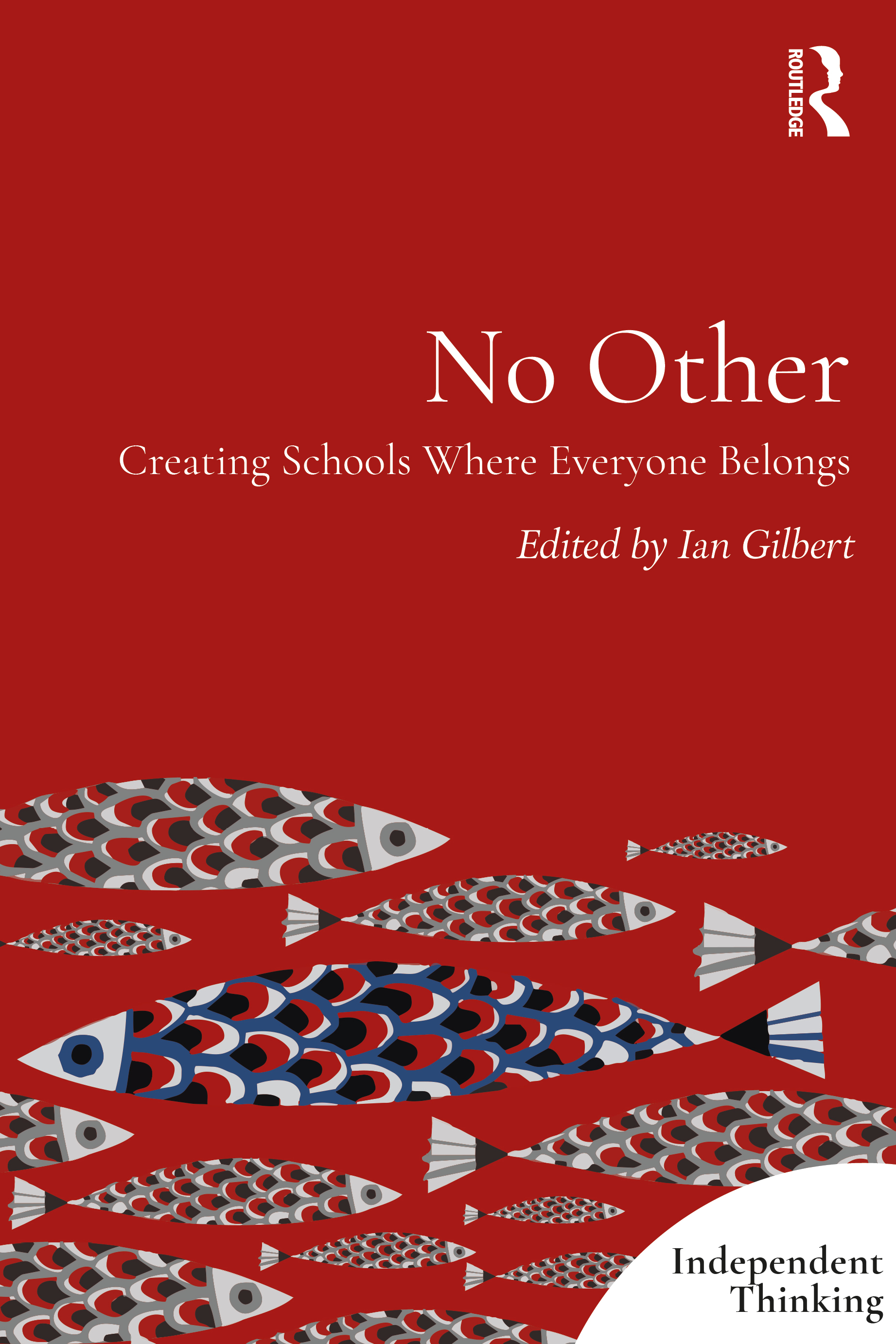
Below are 46 extracts from 46 voices from our forthcoming Routledge title, No Other: Creating Schools Where Everyone Belongs
“For small creatures such as we the vastness is bearable only through love.”
Carl Sagan
From the dedication
“And it is to these people I dedicate this foreword – the unsung heroes, the ones who kept checking in and didn’t take it personally when we didn’t have capacity or failed to access the offer or were too ill or felt there was no point, the ones who led with their hearts in their eyes, who held onto hope not as a demand but as a beacon in the storm, the people we found a way to laugh with and smile together, the bearers of hope in our lives.”
Ellie Costello, Foreword
“The belonging that is created by depriving someone of control is very different from the one that is created by giving it. Of course, agency is the nemesis of every champion teacher’s favourite tool, compliance, and with good cause. Combine agency with criticality and you have resistance and resistance is a very powerful force to have to contend with when you are constantly correcting children and calling it love.”
Ian Gilbert, Introduction
“Can it be possible to practice ‘belonging’ – to have ‘belonging’ as a living value in your school – while the threat of exclusion hangs perpetually in the air?”
Chapter 1- Belonging, If: Inclusion, Exclusion and the Homo Sacer - Tier Blundell
“The arrival of children and young people seeking safety is also an exciting and meaningful opportunity for the whole school community to build their understanding of a complex but important current issue, while tackling misinformation, hostility, and hate.”
Chapter 2 - Children Seeking Sanctuary - Megan Greenwood
“American poet and civil rights activist, Maya Angelou, famously stated that ‘Shakespeare must have been a Black girl’ because his words in Sonnet 29 so closely mirrored her experiences as a Black girl in the Jim Crow South. To look at the curriculum and remove the writing of a 16th century white male from Stratford because he doesn’t reflect the young people in front of us would be unhelpful.”
Chapter 3 - ‘Shakespeare Must Have Been a Black Girl’ - Diversity and Curriculum Design - Jonathan Lear
“Bear in mind, some of these children may have seen sudden and horrific tragedies or have not been able to say goodbye at a funeral or ceremony. These circumstances can prolong and affect their grieving process in a way that many of us could not even comprehend.”
Chapter 4 - ‘A Bit Less Alien’ - Belonging and the Bereaved Child – Lucy Lynch
“All headteachers have the discretion to agree to flexischooling arrangements for any child. This is not the same as a time-limited, part-time, reduced timetable and,crucially, there is no requirement for children to follow the national curriculum on flexischooling days. As such, activities on these days are hugely varied.”
Chapter 5 - Belonging More by Attending Less - The Benefits of Flexischooling - Sarah Sudea
“By holding literacy back until a learner meets an arbitrary threshold, we unintentionally ‘other’ them, excluding them from opportunities to engage with texts, express themselves, and develop their voice. Literacy has become a gatekeeper rather than a gateway. But what happens when we reframe literacy, seeing it as more than decoding or constructing sentences? Instead, what if we view literacy as ‘belonging’, by which we mean access to ideas, the ability to share perspectives, and the means to shape the world. Then literacy is about identity and agency, not just attainment.”
Chapter 6 - Literacy Without Limits - Reframing Reading, Writing, and Oracy Through Inclusion - Sarah Moseley
“I often hear the phrase ‘hard to reach’ when it comes to attendance, whether that is describing children, families or parents. But for the families you serve, ‘hard to reach’ does not mean ‘out of reach’. Accept that they may have a different view of what school is about to you but do what you can to convince them that there is something at school that their child needs.”
Chapter 7 - The Attendance Problem Isn’t an Attendance Problem - Mark Goodwin
“Friday, and Ted entered school with a smile on his face, going on to engage positively in class all day. At lunchtime, Tracey, a member of our support staff, checked in with him to see how he was getting on.
‘Today’s been the happiest day I’ve ever had in school’, he beamed.
When asked how come, his response was equally surprising.
‘I know you all like me.’
Chapter 8 - ‘I Know You All Like Me’ - On Intentional Inclusivity - Rob Metcalfe
“We realised that the fight for LGBTQ+ equity had blinkered us to something far wider ranging and impactful – equity for all. We had lost our collective bearings, and each of us – leadership, parents, staff, hard-line conservatism masquerading as ‘tradition’ – had to shoulder some of the blame.”
Chapter 9 - Don’t Say the P-Word! - LGBTQ+ Awareness in the Traditional School Setting - Andy Low
“In our school, our Museum of Everything anchors our curriculum in joy, story,and imagination. We have replaced rigid one-size-fits-all teaching with topic-led, experience-rich learning that meets children where they are and takes them further than they – and often their teachers and parents – ever thought possible. At its heart is curiosity, a core value that transforms children from mere recipients of knowledge into agents of their own learning.”
Chapter 10 - Belonging, Curiosity, and the Radical Forces of Inclusion - James Searjeant
“It has been estimated that 80 per cent of autistic girls are still unrecognised as autistic at the age of 18. Outdated stereotypes that centre white boys don’t help, and girls are often more socially motivated, better at mimicry, and more likely to internalise distress. They are diagnosed later, if at all, and their needs are routinely underestimated. The education system, with its narrow parameters of ‘normalcy’, renders them invisible.”
Chapter 11 - The Invisible Ones - Supporting Autistic Girls in Education - Cathy Wassell
“Curriculum is where belonging often begins but where it is too often denied. Students can’t feel seen in a system where the stories, voices, and identities reflected are predictably the same and where they never see themselves.”
Chapter 12 - You Belong Here - Cultivating Value, Voice, and Cultural Belonging in All Schools - Gemma Hathaway
“Imagine a bright and passionate Black trainee, heading out for their first day onplacement at school. They are excited and nervous. They are greeted and directed to the staffroom. Although the school is welcoming, the trainee quickly recognises they are the only ethnic minority in the room. As time goes on, they come to realise they are the only Black staff member in the whole school. Uncertainty starts to make itself felt. Do they belong? Will they be judged more harshly? Will their contributions be recognised? Will they be valued? Should they be here in the first place?”
Chapter 13 - Invisible Barriers - Supporting Ethnic Minority Teachers - Rhia Mutombo
“‘Inclusion’ is one of those words schools use liberally, often with little precision and even less conviction. It fills mission statements, appears on banners, frames strategy documents, and carries the aura of ethical seriousness. Yet all too often it functions as a form of decoration: the performance of virtue without any legitimate redistribution of power. In many classrooms, inclusion translates into little more than permission to be in the room. Schools that mistake access for belonging, confuse attendance with education. Students are granted presence but not the real measure of whether education fulfils its purpose – belonging.”
Chapter 14 - ‘I Do Not Think It Means What You Think It Means’ - Inclusion Beyond Rhetoric in International Schools - Nigel Winnard
“If we are serious about equity, diversity, and inclusion, we cannot leave parental engagement to chance. Belonging will not be achieved through occasional newsletters, annual parents’ evenings, or one-off coffee mornings. It is not built through occasional contact but through consistency, trust, and a genuine sense of partnership between home and school. It requires a deliberate, sustained approach that places parents and carers at the heart of the school’s work every day.”
Chapter 15 - Belonging Begins at Home - How Parental Engagement Creates Inclusive Schools - Karen Dempster and Justin Robbins
“While, more recently, there have been attempts to diversify the curriculum through inclusion of topics such as ‘migration’ at GCSE, or attempts to include role models from different backgrounds, the fundamentals of the British curriculum have not changed hugely since its Thatcher-era inception. There is still a heavy focus on Empire as a progress endeavour for Great Britain. Trade is centralised, violence minimalised and narratives are select, focusing on figures such as Churchill and Henry VIII, rather than colonised voices. The Industrial Revolution looks at innovation, but not the colonial exploitation that drove it.”
Chapter 16 - Achieving Belonging by Dismantling Hierarchies in the Curriculum - Bennie Kara
“When we move our focus from ‘What is not working?’ to ‘What is working despite all the difficulties?’, we are able to make a real difference in the lives of all children and young people.”
Chapter 17 - What’s Right with You? Happiness, Belonging, and the Finnish Perspective - Kaisa Vuorinen
“In the name of social justice, therefore, it is vital that all teachers properly explore their own value systems and the stereotypical ideas they hold, challenge their cultural and social assumptions and question the deficit model they may accredit to disadvantaged pupils. If not, the prospect of low expectations and less effective teaching of these children appears to be a real risk.”
Chapter 18 - Prejudice, Labelling, and Low Expectations: Challenging Teacher Assumptions Elizabeth Farrar
“It’s easy to blame loneliness on bullying but I don’t think it’s as deliberate as that, at least much of the time. I think the reason it happens so often in schools around the world has more to do with oversight and dismissal. It persists because of our failure to notice it, to acknowledge it and, then, to act. Or maybe it’s just denial?”
Chapter 19 - The Lonely Child - Mihaela Beatrice Sîrbu
“How is respect shown beyond an expectation of stillness or silence? Can you distinguish between genuine engagement and quiet compliance? What control do you exert over their bodies as well as their minds? Does the climate you create in the name of learning encourage belonging and acceptance or conformity and deficit? Is obedience prioritised over independence? Are the systems you use for control stoking exclusion and division? Are curiosity and dignity factored into your behavioural practices?”
Chapter 20 - The Hidden Exclusions of Quiet Compliance - Julia Hancock
“Acceptance is the mindset; allyship is the action.
It means standing with others, especially when they are marginalised or harmed.
Belonging creates the foundation for acceptance but if we stop there, we risk
mistaking comfort for courage.
Allyship asks us to move beyond inclusion as a concept and into inclusion as a practice.”
Chapter 21 - Thirteen Reflections on Belonging, Authenticity, and Allyship - Alison Kriel
“From a statistically significant dataset of over 26,000 students and staff, only 12 per cent of students said they felt fully included in their school environment. A third of students with SEND strongly disagreed that teachers listen to their views. And, when extrapolated nationally, nearly three million young people report feeling invisible in the curriculum.”
Chapter 22 - Inclusion by Intention: An Inclusion Champion in Every Classroom - Nicole Ponsford
“Adoption and sexuality aren’t the same thing, but they sit side by side in the reality of many families like mine. I’m a gay dad raising an adopted son with my husband. For us, adoption and LGBTQ+ identity aren’t two separate issues – they’re part of the same family story. When schools fail to talk about adoption, it leaves my son vulnerable. When schools fail to talk about LGBTQ+ people, it leaves me vulnerable. And when either of us is left out, the silence chips away at the trust we place in schools to be safe, supportive places.”
Chapter 23 - Breaking the Silence: Speaking Out on Inclusion and Identity - Ian Timbrell
“In our research on school belonging, we show that different aspects of belonging may be differentially salient for children.8 For children from non-dominant or disadvantaged groups (low income, minority ethnic groups, girls) social identity may be more important but for more dominant or advantaged groups (white students, those not on free school meals, and boys) peer identity is prioritised. This suggests that schools must be sensitive to the different identity needs of their student cohorts.”
Chapter 24 - Belonging, Identity, and the Educational Binds of Poverty - Ceri Brown
“The performative processes that have evolved have damaged teachers professionally, and, for some older teachers, this may ultimately prove fatal to their careers. My empirical evidence shows that older teachers are conscious of the nuances of the system that forces them to inhabit a professional world of performance metrics, that measures only what can be made measurable. They see the damage that this and the marketised model has caused to the profession and to them personally and professionally. They are, variously, saddened, angered, fearful, and cowed by their weakened position and the frequently ill-conceived metrical power that is wielded against them nationally and at an institutional level.”
Chapter 25 - I, (Older)Teacher - Elaine Fenech
“The evidence is clear. Bias – especially implicit bias – shapes how children’s behaviours are interpreted, which in turn affects whether those behaviours are seen as signals for support or triggers for sanction. These perceptions matter. They can open the door to timely mental health intervention or close it entirely, often along lines of ethnicity.”
Chapter 26 - Teacher Bias, Ethnicity, and Perceptions of Mental Health in Schools - Maddi Popoola
“Asking ourselves how we can help children recognise and celebrate their own unique selves, how we can nurture their understanding of lives that may look different to their own and how we can help them embrace this diversity in ways that are meaningful to them – these questions are right at the heart of the Early Years Foundation Stage.
Chapter 27 - A Fish in Water: Belonging in the Early Years - Ruth Swailes
“Ultimately, ensuring collaboration between families and schools is not about grand gestures or complex interventions. It is about listening, understanding, and working together. The role of independent guidance for families from someone knowledgeable about the education system and its possibilities can be transformative for parents, carers, and schools. With clear communication, realistic expectations, and shared responsibility, we can create environments in which all children – especially those with additional needs – belong and thrive.”
Chapter 28 - Finding Common Ground: Families and Schools Working Together so that Children Thrive - James Harris
“Lacking the ‘correct’ cultural capital to sufficiently prepare children for school appears in many forms, including language competencies, behavioural and academic expectations, as well as curriculum knowledge, which has incidentally come under scrutiny over recent years for having a white middle-class bias.11 Despite GRT communities being incredibly diverse, each with their own rich histories and cultures, GRT students may find themselves marginalised by this, as their culture is not part of the dominant culture. Notably, their nomadic lifestyle is both a significant part of their world yet is simultaneously also one of the causes of their exclusion.”
Chapter 29 - Gypsy, Roma, and Traveller Children: Rich in the Wrong Currency – Sarah Fell
“At their heart, courageous conversations are about human connection. They remind us that inclusion is not achieved through policy statements alone, but through the daily practice of listening with empathy and speaking with honest integrity. Schools that foster such dialogue move beyond tolerance towards belonging – a culture where difference is not merely accepted but celebrated as a source of strength.”
Chapter 30 - Holding Courageous Conversations - Hannah Wilson
“I often come across situations where neurodiverse students have had an altercation with another child or adult and hear the words, ‘There was no trigger’. There is always a trigger. A ‘neurotypical’ brain may not perceive it as such, but it’s a trigger all the same. Once you have an insight into the way a neurodiverse brain works, you immediately begin to see triggers all around.”
Chapter 31 - Belonging and Neurodiversity in the Inclusive Classroom - Katie Goodwin
“Among the many questions you will have been asked recently about data and standards, progress and behaviour, you may not have been asked, to what extent is love part of your job?”
Chapter 32 - Love Is Not an Intervention - Zoya Wallington
“The school curriculum, done well, can serve as a powerful space for inclusion. However, when Muslims are only associated with extremism, conflict, or safeguarding, this reinforces narrow stereotypes. For example, Muslim contributions to fields including mathematics, astronomy, medicine, literature, and philosophy are often overlooked despite their importance to intellectual history. What do the students (and teachers) in your school know about Baghdad’s 8th-century Bayt al-Hikma or House of Wisdom, for example?”
Chapter 33 - Muslim Belonging in Education: Anti-Muslim Hate, Curriculum Reform, and Ethical Safeguarding Practice - Javeria Khadija Shah
“In the past, I chose not to know where students came from – a well-intentioned approach of deliberate ignorance. I made it my mission not to know if a student was ‘internal’ or ‘external’ because I wanted each year group to be a fresh cohort of students with everyone seen through the same lens. Of course, an individual’s context was important and I always worked to get to know all students as individuals, but I believed that treating everyone the same would level the playing field.
I was wrong.”
Chapter 34 - You Don’t Know Me Yet: Cultivating Belonging for New Sixth Formers - Laura Newell
“When you know you have a limb-different child coming to your class, arrange a meeting with parents and carers and their child before they start. Then, when you talk to the family, be open and upfront straight away. Don’t let the child’s limb difference become the ‘elephant in the room’.”
Chapter 35 - Limb Difference in the Classroom - Jane Hewitt
“The tension that evolves and begins to dominate in adolescence is the need to feel more connected, to belong, to find acceptance for who you are. How can you fit in but also be true to your emerging self. Paradoxically, we can help them learn about themselves by helping them ‘unself’ – to look beyond what Iris Murdoch referred to as our ‘fat, relentless ego’.”
Chapter 36 - Learning Through Dialogue: Unselfing, Belonging, and the Power of Conversation - Susan Kyne Andrews
“For me, care and belonging go hand in hand.
When you know someone cares for you, you feel safe.
When you care for someone else, you know you are part of something bigger than you are.
And, when you feel like you truly belong, you can take up the important work of caring for yourself.”
Chapter 37 - I Care; You Care; We Care: Building Cultures of Inclusion, Diversity, and Well-being in Schools - Nina Jackson
“Rather than seeing heritage languages as a ‘problem’ to be fixed, an asset-based pedagogical approach focusses on what a child brings to the classroom from home, from family, from lived experience. It acknowledges that what students already know, and how they understand things, is not only important but also deeply connected to their home language.”
Chapter 38 - ‘Say it Again, Only Whiter’: Rethinking EAL - Rory File
“Our character education programme positively reinforces the behaviour we want to see from our school community, it celebrates students when they get things right and it encourages the development of practical wisdom in our young people. When individuals have the courage to stand up for justice and to put moral virtues into practice, through teamwork, leadership, democracy, and enacting the civic virtues, we can create a space where all people feel they belong.”
Chapter 39 - Learning About Versus Learning to Be: How Character Education Can Support Inclusion - Melodie Harmer
“Peer coaching not only supports diversity and inclusion by providing a non-hierarchical space for everyone to build the essential skills and habits of empathy, it also fosters a culture of belonging by connecting staff and pupils across different backgrounds and levels. In this way, it helps to move diversity and inclusion from boxes to be ticked to essential elements of an embedded culture that prioritises empathetic listening and support.”
Chapter 40 - Peer Coaching: The Glue That Connects the Whole School Community - Jackie Beere
“The previous Multi-Academy Trust we were part of dismantled our sense of community connection through actions such as taking down all the historical photos of the school, the pupils, and its community. We are rebuilding that now as we know connection with the past and the particular history of both the school and the town is essential for belonging.”
Chapter 41 - Behaviour, Attendance, and Belonging: The Six Principles of the Healing Way - Stephen Logan
“To truly belong, young people need to be nurtured to speak as themselves. This means we create opportunities for them to be able to present themselves through their home language, to speak in their authentic accent or dialogue, to share their culture, to express their gender identity or sexuality safely and without judgement, and to celebrate any and all disability, difference, and diversity. In this way, they can be both physically and metaphorically authentic and, in doing so, experience genuine belonging.”
Chapter 42 - ‘Here I am’: Belonging and Authentic Oracy - Rachel Higginson
“This book, as you have seen, is about true belonging. It is about working with and loving the ones you have. It is about opening your doors, pulling down barriers, and making schools feel like safe and accepting places for all young people. It’s about recognising that belonging – true belonging – attends to the emotional worlds of young people, adapting to their needs. What’s more, in a place where you truly belong, you are not only safe, but you can also contribute to the direction of travel of that organisation. Your voice is not simply heard, but welcomed and considered. Instead of compliance you have consent. Instead of authority you have agency. Instead of exclusion you have inclusion.”
Chapter 43 - Wired to Be Loved - Debra Kidd
No Other: Creating Schools where Everyone Belongs is the first title in our new Independent Thinking Series to be published by Routledge this Autumn.
Use the code 26ESE4 for a special 20% discount, valid until March 2027.
Enjoy a free no-obligation chat.
Haggle a bit. Make a booking.
Call us on +44 (0)1267 211432 or drop us a line at learn@independentthinking.co.uk.
About the author
Ian Gilbert
Ian Gilbert is an award-winning writer, editor, speaker, innovator and the founder of Independent Thinking. Currently based in Finland, he has lived and worked in the UK, mainland Europe, the Middle East, South America and Asia and is privileged to have such a global view of education and education systems.